
A space maintainer is a small appliance that holds open the gap left by a baby tooth lost earlier than expected, so neighbouring teeth don't drift into that space before the permanent tooth is ready to take its place.
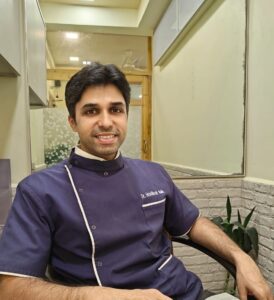
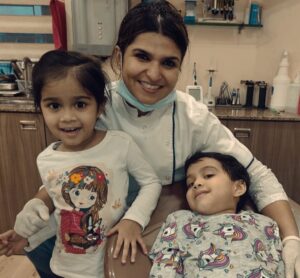
At PlanDental in Mahim West, space maintainers are fitted by Dr. Hrishikesh Naik and Dr. Nisha Naik, both MDS in Prosthodontics and Implantology. Whether one is actually needed is assessed case by case. Read more about the clinic before you book.
Parents usually book this for: a baby tooth extracted early a baby tooth lost to injury following up after root canal for children a dentist recommending space maintenance
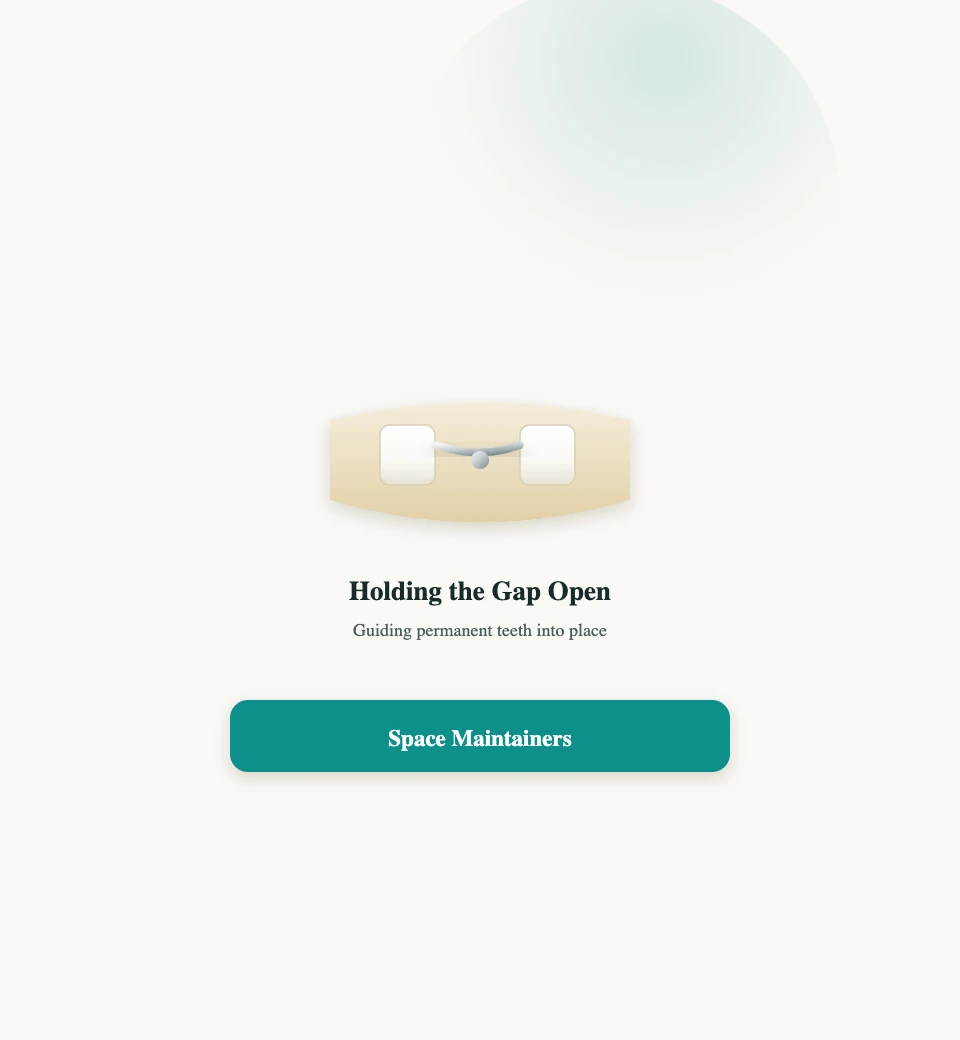
A space maintainer at PlanDental in Mahim, Mumbai is a small fixed or removable appliance placed after a baby tooth is lost earlier than expected — from decay, injury, or extraction — to hold that space open until the permanent tooth beneath it is ready to erupt. The American Academy of Pediatric Dentistry treats this as a reasonable, individualised decision rather than an automatic step for every early loss — factors like which tooth was lost, how much time has passed, and how close the permanent successor is to erupting all matter.
Baby teeth aren't just placeholders — they actively hold the neighbouring teeth in position. When one is lost well before its permanent successor is ready to erupt, nearby teeth can gradually drift or tip into the gap, narrowing the space the permanent tooth needs. A space maintainer physically occupies that gap, keeping it at roughly its original width.
The AAPD frames this as an individualised decision based on several factors, not a one-size-fits-all rule.
It's worth being upfront here: the AAPD's own guidance notes that while it's prudent to consider space maintenance after early tooth loss, strong consensus evidence on how effectively space maintainers actually prevent or reduce crowding is limited. In practice, the decision leans on individualised clinical factors — the specific tooth lost, time since loss, the child's dental age, root development of the permanent successor, and the child's ability to tolerate and keep the appliance clean — rather than a single proven rule.
A fixed appliance for a single missing tooth, anchored to a neighbouring tooth.
A fixed appliance spanning both sides of the lower arch.
A removable appliance that can also help with certain habits.
Confirms the space situation and how developed the permanent successor's root is.
An impression of the teeth is taken so the appliance is custom-fitted.
The maintainer is cemented in place (fixed types) or fitted and checked (removable types).
The appliance and the erupting permanent tooth are monitored at routine visits.
The maintainer is removed once the permanent tooth has erupted into place.
Space maintainer cost in Mumbai depends on the type of appliance and how many teeth are involved. PlanDental doesn't publish a fixed figure here — call or WhatsApp and the clinic will talk you through it after the assessment.
This section describes what affects cost, not a quotation. Actual cost is confirmed after the assessment.
Whether one is worthwhile depends on how close the permanent tooth is to erupting — not just that a baby tooth was lost. Send an X-ray or exam notes on WhatsApp for a straight opinion.
A brief adjustment period is normal as your child gets used to the appliance.
Extra care around the appliance while brushing helps prevent plaque buildup nearby.
The appliance and the successor tooth's progress are checked periodically.
The maintainer is removed once it's done its job.
A space maintainer reduces the chance of drift, but published evidence doesn't establish it as a guaranteed prevention of future crowding or misalignment.
A dislodged, broken, or lost appliance needs prompt attention — left unaddressed, it can't do its job.
Poor oral hygiene around the appliance can itself contribute to decay, so it isn't a "set and forget" solution.
If it's interfering with the successor tooth's eruption rather than helping, it's adjusted or removed.
The fitting visit is straightforward and doesn't usually require anaesthesia — an impression is taken, and the appliance is fitted and adjusted for comfort. Most children adapt to it within a few days. Follow-up visits are quick checks rather than lengthy procedures.
X-ray-based root development check, not a blanket recommendation.
Presented as a sensible precaution, not an overstated guarantee.
Step-free walk-in access, Guru Nanak Road, Mahim West — no stairs.
Same Guru Nanak Road address, next to Citylight Cinema, for over a decade.
No — it depends on how close the permanent successor is to erupting and other individual factors. Sometimes monitoring alone is appropriate.
Until the permanent tooth beneath it is ready to erupt, which varies by child and by which tooth was lost.
No — it's a reasonable precaution to reduce drift, but evidence doesn't establish it as a guaranteed way to prevent future crowding or misalignment.
It should be checked promptly — a dislodged appliance can't hold the space properly and may need to be re-cemented or replaced.
No — it's a straightforward fitting that usually doesn't require anaesthesia, with a brief adjustment period afterward.
If not kept clean, plaque can build up around it. It's also checked periodically to make sure it isn't interfering with the successor tooth's eruption.
1. American Academy of Pediatric Dentistry — "Management of the Developing Dentition and Occlusion in Pediatric Dentistry," policy and clinical guidance. aapd.org
Call or WhatsApp PlanDental to check today's availability or ask a question — no forms to fill.
Disclaimer: Information provided on this page is for educational purposes only. Individual treatment plans and outcomes vary based on clinical evaluation by a qualified dentist.