

Medically reviewed by Dr. Hrishikesh Naik, MDS Prosthodontics & Implantology · Last updated: September 2026
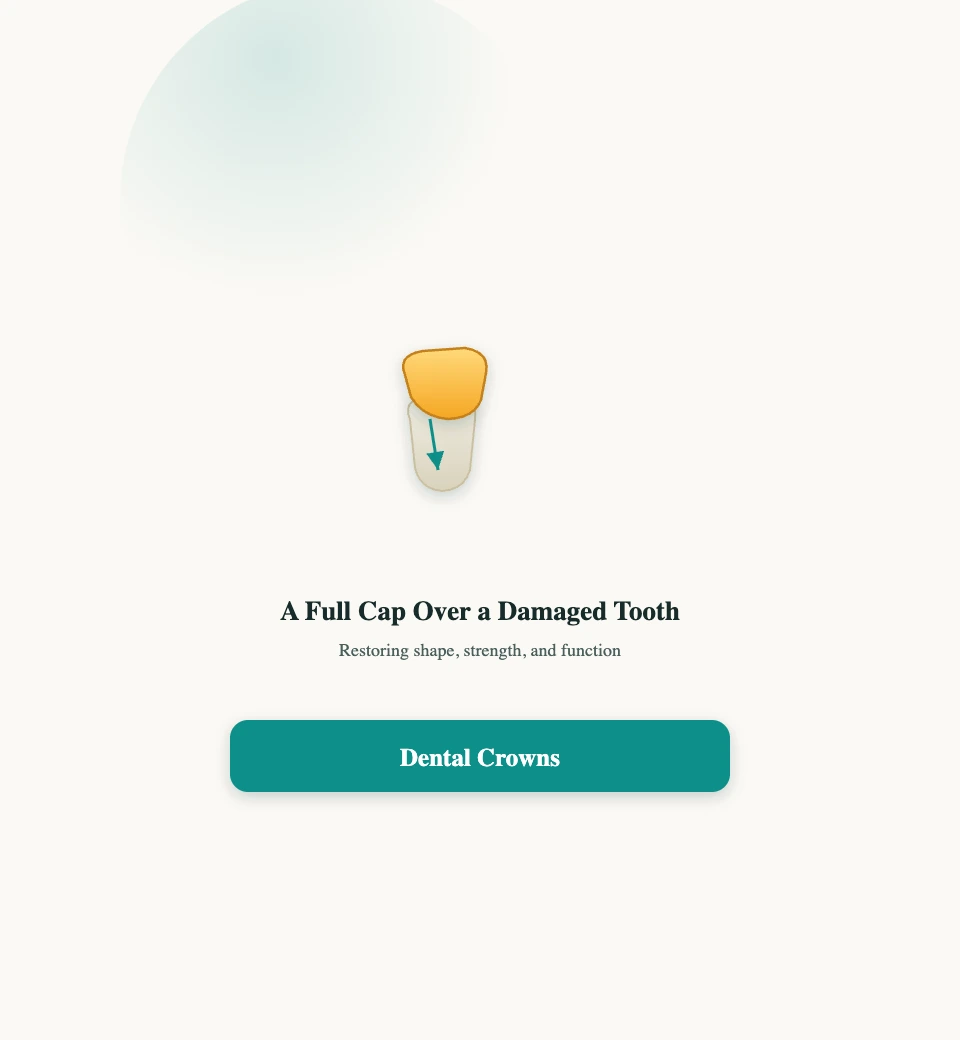
A crown covers a tooth entirely, restoring its strength and shape when there’s too much damage for a filling to handle — from a large cavity, a fracture, or after root canal treatment.
At PlanDental in Mahim West, crowns are placed by Dr. Hrishikesh Naik and Dr. Nisha Naik, both MDS in Prosthodontics and Implantology — crown and bridge work is a core part of prosthodontic training. Read more about the clinic before you book.
Patients usually book this for: a tooth needing protection after root canal a large, failing filling a cracked or fractured tooth a worn-down back tooth a badly discoloured or misshapen tooth
Call 088281 23599
WhatsApp Us
Same-day and urgent dental appointments are accommodated where the day’s schedule allows — call or WhatsApp to check today’s availability.
*General ranges reported across comparative studies of crown materials — see References below. Individual results vary.
A dental crown at PlanDental in Mahim, Mumbai is a cap that covers a tooth entirely, restoring its shape, strength, and function when a filling alone isn’t enough — typically after root canal treatment, a large fracture, or extensive decay. Unlike a veneer, which covers only the front surface for cosmetic reasons, a crown covers the whole tooth and is used primarily for structural protection.
A filling works by bonding a repair material into a cavity that still has enough surrounding healthy tooth structure to support it. Once too much structure is lost — from decay, a fracture, or the access needed for root canal treatment — a filling no longer has enough to hold onto reliably, and the remaining tooth is at real risk of cracking under normal chewing forces. A crown solves this by covering the entire tooth above the gum line, distributing chewing forces across the whole cap rather than concentrating them on weakened tooth structure.
A crown isn’t just a bigger filling — it changes how chewing forces are distributed across the tooth entirely.
A crown is used specifically for structural protection — where the goal is purely cosmetic and the tooth is otherwise sound, a more conservative option usually fits better.
Offered at PlanDental
High fracture resistance with a natural-looking finish.
Offered at PlanDental
The most natural translucency, well suited to front teeth.
Offered at PlanDental
A metal substructure with a porcelain outer layer for strength and appearance.
Material choice depends on where the tooth is, how much biting force it takes, and how visible it is — this is discussed at your consultation.
The tooth is reshaped under local anaesthesia to make room for the crown.
A precise impression captures the prepared tooth for the lab to fabricate the crown.
A temporary crown protects the prepared tooth while the permanent one is made.
At the second visit, the finished crown is checked for fit and bite, then cemented in place.
The two-visit process allows time for a precisely fabricated crown rather than rushing the fit.
Dental crown cost in Mumbai depends on the material chosen and which tooth is being treated. PlanDental doesn’t publish a fixed figure here — call or WhatsApp and the clinic will talk you through it after the exam.
Tends to push the estimate up: zirconia or all-ceramic materials, a tooth needing a core build-up before the crown.
Tends to keep it simpler: a back tooth where aesthetics matter less, straightforward preparation.
This section describes what affects cost, not a quotation. Actual cost is confirmed only after an exam.
A crown is a significant step up from a filling — worth confirming it’s genuinely needed. Send your X-ray or exam notes on WhatsApp for a straight opinion.
Avoid sticky or very hard foods that could dislodge the temporary crown.
Mild sensitivity to temperature is common as the tooth adjusts.
The crown functions like a natural tooth for eating and brushing.
Routine check-ups monitor the crown’s fit and the gum tissue around it.
A well-fitted crown functions and feels close to a natural tooth once you’ve adjusted to it.
✕
A crown doesn’t treat decay or infection underneath it — that needs to be addressed before the crown is placed.
✕
Gum disease around a crowned tooth still needs separate treatment — the crown itself doesn’t protect against it.
✕
A crown reshapes the visible tooth but relies on healthy root and bone support underneath to function long-term.
A crown restores what’s visible above the gum — the health of what’s below it still needs its own attention.

MDS, Prosthodontics & Implantology

MDS, Prosthodontics & Implantology
Crown and bridge work is a core specialty, not incidental general dentistry.
Recommendations weigh location, force, and appearance together.
Step-free walk-in access, Guru Nanak Road, Mahim West — no stairs.
Same Guru Nanak Road address, next to Citylight Cinema, for over a decade.
Full guide to our Mahim West & LJ Road clinic
Open in Google Maps for Directions
A ground-floor, step-free clinic on Guru Nanak Road, Mahim West — next to Citylight Cinema, easy to reach from Dadar, Matunga, and Bandra.
Typically two visits — one to prepare the tooth and fit a temporary crown, and a second, once the permanent crown is fabricated, to fit it.
Studies report crowns commonly lasting 10 to 15 years or more depending on the material and how well they’re cared for, with some materials like metal alloys lasting even longer.
All-ceramic or porcelain crowns generally offer the most natural translucency, making them well suited to visible front teeth.
The tooth is numbed before preparation, so the procedure itself shouldn’t be painful. Mild sensitivity for a few days afterward is common.
No — crowns are also placed on teeth with healthy nerves, for structural reasons like a large fracture or extensive decay. Root canal treatment is only needed if the nerve itself is affected.
A crown covers the entire tooth for structural protection. A veneer covers only the front surface and is used mainly for cosmetic reasons on an otherwise structurally sound tooth.
1. Comparative clinical survival data for porcelain, zirconia, and porcelain-fused-to-metal crowns, summarised across multiple peer-reviewed prosthodontic studies. General material comparisons available via PubMed Central. ncbi.nlm.nih.gov/pmc
Medically reviewed by Dr. Hrishikesh Naik, MDS Prosthodontics & Implantology, PlanDental, Mahim. Last updated 21 September 2026. Next scheduled review: March 2027. This page is for general information and does not replace an in-person dental examination.
Call or WhatsApp PlanDental to check today’s availability or ask a question — no forms to fill.
Often precedes a crown on a back tooth.
Uses crowns on neighbouring teeth to replace a missing one.
A more conservative cosmetic option for structurally sound teeth.
Disclaimer: Information provided on this page is for educational purposes only. Individual treatment plans and outcomes vary based on clinical evaluation by a qualified dentist.