

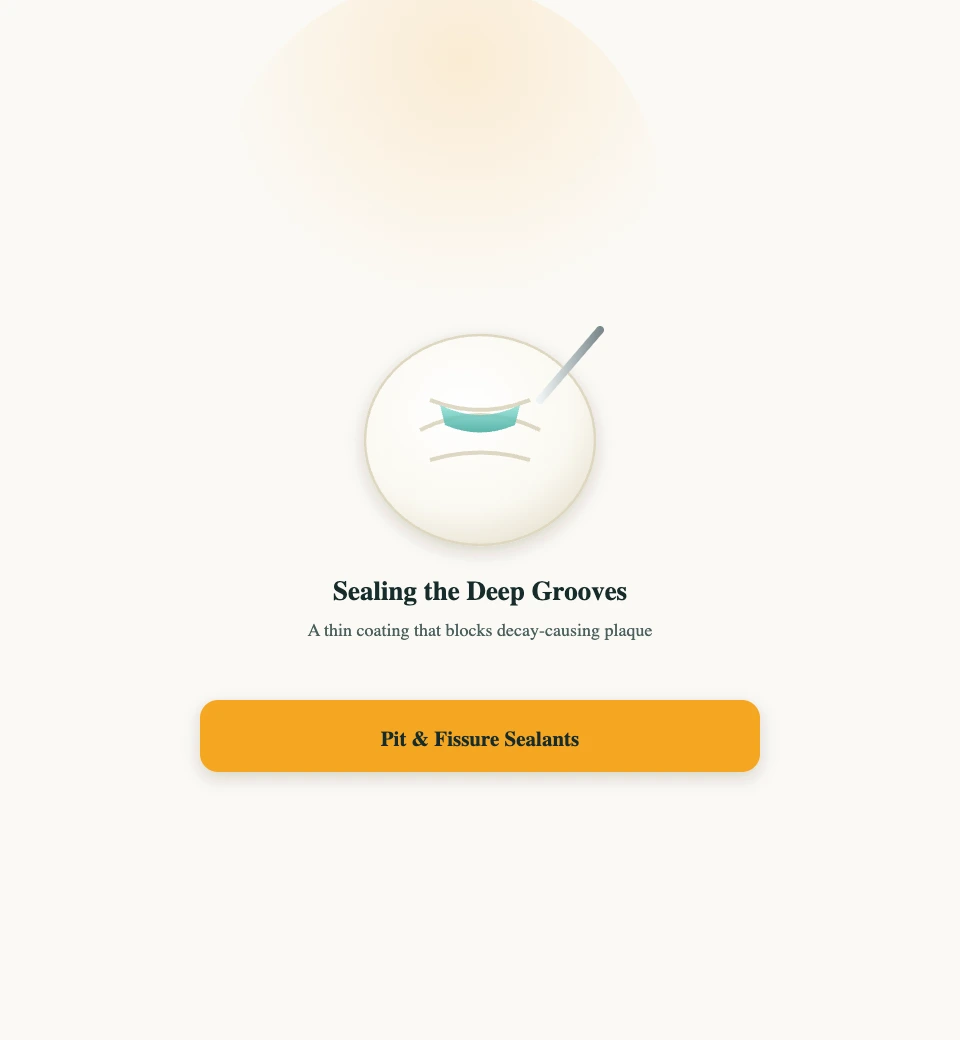
Sealants are a thin protective coating painted onto the chewing surface of back teeth, sealing off the deep grooves where a toothbrush struggles to fully clean — one of the simplest, most evidence-backed ways to prevent a cavity before it starts.
At PlanDental in Mahim West, sealants are applied by Dr. Hrishikesh Naik and Dr. Nisha Naik, both MDS in Prosthodontics and Implantology, for children and adults alike. Read more about the clinic before you book.
Patients usually book this for: newly erupted back teeth deep grooves that trap food a child at higher cavity risk a molar that's decay-free but grooved wanting extra protection between check-ups
*Per pooled trial data in the 2016 ADA/AAPD clinical practice guideline — see References below.
Pit and fissure sealants at PlanDental in Mahim, Mumbai are a thin coating applied to the chewing surfaces of back teeth — mainly molars — to seal the deep pits and grooves where plaque and food debris collect. According to a joint ADA/AAPD clinical practice guideline, sealants reduce the incidence of decay in these grooves by 76% over two to three years compared with no sealant. It's quick, comfortable, and doesn't require any drilling or anaesthesia.
The chewing surfaces of molars and premolars have natural pits and fissures — narrow grooves that help with chewing but are often too deep and narrow for a toothbrush bristle to fully clean out. Plaque and food particles that settle into these grooves can sit there for extended periods, which is why back teeth are especially prone to decay starting in exactly these spots.
A sealant physically fills and covers these grooves with a smooth, cleanable surface, so bacteria and food debris have nowhere to hide and nothing to feed on there.
A 2016 evidence-based clinical practice guideline, developed jointly by the American Dental Association and the American Academy of Pediatric Dentistry, reviewed randomized controlled trials comparing sealants to no sealant. Pooled data showed sealants reduced the incidence of decay in the pits and fissures of permanent molars by 76% over two to three years of follow-up. The guideline panel found several sealant material types — including resin-based sealants and glass ionomer-based materials — to be acceptable options, without preferring one over another.
A protective coating over the grooves of chewing surfaces.
Strengthens enamel across the whole tooth, not just the grooves.
The right treatment once decay has already formed a cavity.
The chewing surface is cleaned and thoroughly dried so the sealant bonds properly.
A mild conditioning solution roughens the enamel slightly to help the sealant adhere.
The sealant material is painted directly into the grooves of the tooth.
The sealant is set — sometimes with a curing light — and the bite is checked so it feels comfortable.
Sealant cost in Mumbai is generally calculated per tooth, since each molar or premolar is sealed individually. PlanDental doesn't publish a fixed figure here — call or WhatsApp for details.
This section describes what affects cost, not a quotation. Actual cost is confirmed at your visit.
Early, non-cavitated grooves and actual cavities look different and need different treatment. Send a photo or exam notes on WhatsApp for a straight opinion.
Normal eating and drinking resumes right away — there's no numbness or downtime.
Brushing and flossing continue as normal around the sealed tooth.
Sealants are checked for wear or chipping at routine dental visits.
A worn or partially lost sealant can be reapplied.
They don't repair a tooth that already has a cavity — that needs a filling.
They only protect the chewing surface — decay between teeth or along the gum line still needs to be prevented separately, through brushing, flossing, and fluoride.
They can wear down or chip over time, so they're checked, not assumed permanent, at each check-up.
It's quick and comfortable — no drilling, no numbing, and no discomfort. Each tooth takes only a few minutes, and the visit is often combined with a routine check-up or cleaning. It's a particularly easy visit for children, since there's nothing uncomfortable involved.

Sealants are recommended based on real groove depth and risk, not applied routinely to every tooth.
Sealant condition is reviewed at routine check-ups, not left unchecked for years.
Step-free walk-in access, Guru Nanak Road, Mahim West — no stairs.
Same Guru Nanak Road address, next to Citylight Cinema, for over a decade.
They can last several years, but wear varies by individual — they're checked at each routine check-up and reapplied if needed.
No — they're most commonly recommended for children on newly erupted permanent molars, but adults with deep, decay-free grooves can benefit too.
No — there's no drilling or anaesthesia involved. It's a quick, comfortable procedure.
Sealants are for sound, decay-free grooves. A tooth that already has a filling on that surface doesn't need a sealant there.
No — they protect specifically the chewing-surface grooves. Daily brushing, flossing, and fluoride still matter for the rest of the tooth.
A joint ADA/AAPD guideline found sealants reduced decay incidence in treated grooves by 76% over two to three years compared with no sealant.
1. American Dental Association & American Academy of Pediatric Dentistry — "Evidence-based clinical practice guideline for the use of pit-and-fissure sealants," Journal of the American Dental Association, 2016. jada.ada.org
Call or WhatsApp PlanDental to check today's availability or ask a question — no forms to fill.
Disclaimer: Information provided on this page is for educational purposes only. Individual treatment plans and outcomes vary based on clinical evaluation by a qualified dentist.