

Wisdom tooth pain has a recognisable pattern — pain at the very back of the jaw, sometimes with swelling over a partially visible tooth — and it's rarely a one-time event if the tooth is genuinely impacted.
At PlanDental in Mahim West, wisdom tooth pain is assessed by Dr. Hrishikesh Naik and Dr. Nisha Naik, both MDS in Prosthodontics and Implantology. Read more about the clinic before you book.
People search this for: pain at the very back of the jaw swelling around an emerging tooth recurring pain that keeps coming back difficulty opening the mouth fully pain that flares with a cold or stress
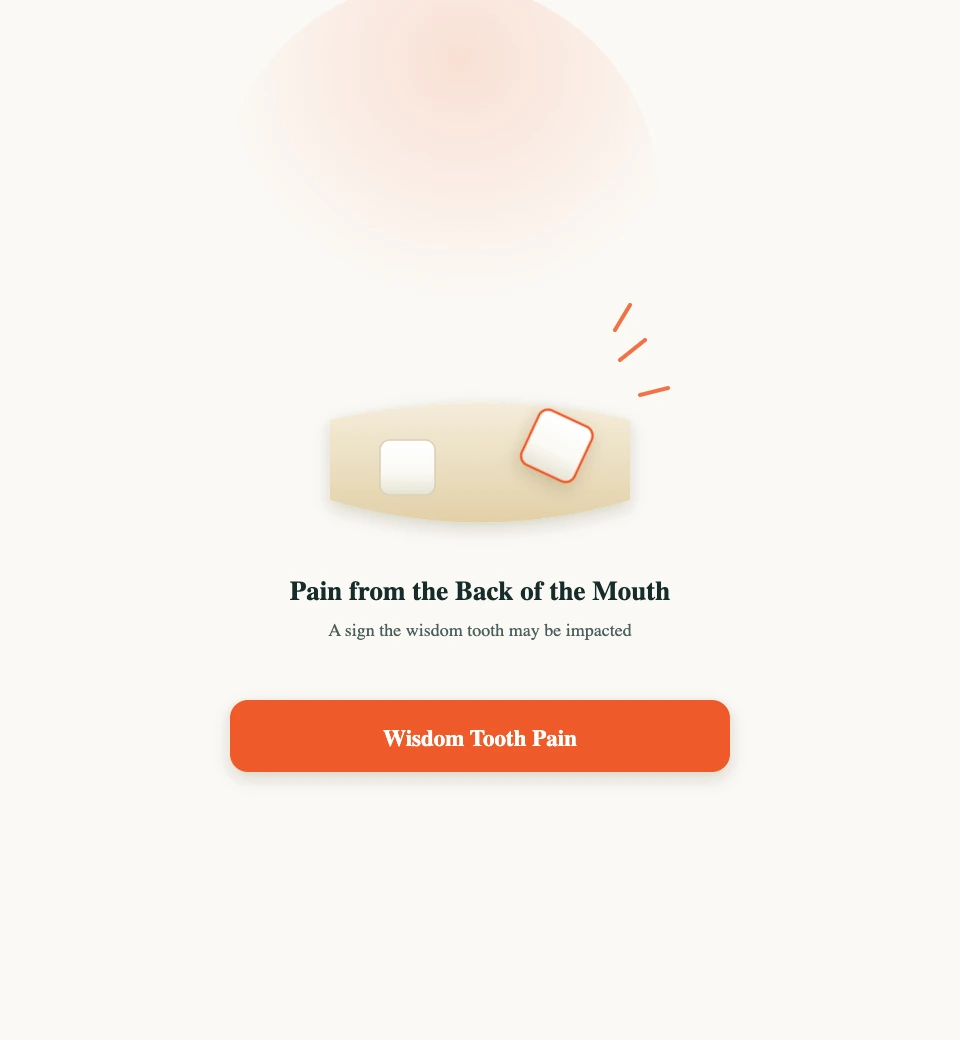
Wisdom tooth pain is assessed at PlanDental in Mahim, Mumbai by exam and X-ray to confirm whether a wisdom tooth is impacted, only partially erupted, or crowding a neighbouring tooth. The most common pattern is pain and swelling at the very back of the jaw that recurs periodically rather than resolving on its own — which is why it often points toward Wisdom Tooth Removal as the definitive treatment, covered in full on that page.
Wisdom teeth are the last teeth to erupt, and by the time they try to, there's often not quite enough room for them to come in fully or in a good position. A partially erupted wisdom tooth leaves a flap of gum tissue over part of the tooth, which traps food and bacteria underneath — this is what causes the periodic swelling and pain known as pericoronitis. Because the space problem doesn't resolve on its own, the pain tends to recur rather than being a single, one-off event.
A gum flap over a partly emerged tooth traps food and bacteria, causing recurring swelling.
The tooth is stuck beneath the gum or bone, unable to erupt into a normal position.
An angled wisdom tooth can push against the tooth in front of it, causing pain there too.
Its position at the very back often makes a wisdom tooth genuinely difficult to clean well.
The definitive treatment for a wisdom tooth causing recurring pain.
For a fully erupted wisdom tooth without complex positioning.
Recurring pain at the back of the jaw usually means the underlying cause hasn't been addressed yet. Send your details on WhatsApp for a straight opinion.
Swelling that spreads beyond the local area toward the cheek or jaw needs urgent evaluation.
Fever alongside wisdom tooth pain can indicate the infection is spreading.
Difficulty swallowing or fully opening your mouth is a sign the infection needs prompt attention.


Impaction and angle are assessed properly before any treatment plan.
Flare-ups are accommodated where the day's schedule allows.
Step-free walk-in access, Guru Nanak Road, Mahim West — no stairs.
Same Guru Nanak Road address, next to Citylight Cinema, for over a decade.
A partially erupted wisdom tooth creates a gum flap that repeatedly traps food and bacteria, so the underlying cause remains even when a flare-up settles — which is why it tends to recur.
A single episode may settle temporarily, but if the tooth's position hasn't changed, the same triggers usually cause it to return.
Most recurring pain from an impacted or partially erupted wisdom tooth is resolved by removal, though the exact approach depends on the tooth's position, confirmed by X-ray.
Yes — an angled wisdom tooth can press against the molar in front of it, causing pain that feels like it's coming from that neighbouring tooth.
Mild, localised swelling that comes and goes is common with pericoronitis, but swelling that spreads, or comes with fever, needs prompt attention.
This page covers understanding the pain itself and its causes. Wisdom Tooth Removal covers the full procedure, aftercare, and what to expect if removal is the right treatment.
Call or WhatsApp PlanDental to check today's availability or ask a question — no forms to fill.
Disclaimer: Information provided on this page is for educational purposes only and is not a substitute for professional dental advice, diagnosis, or treatment.