

Root canal treatment on a baby (primary) tooth works differently from an adult root canal — the goal is keeping the tooth healthy until it naturally falls out, using a filling material designed to resorb along with the tooth's own root.
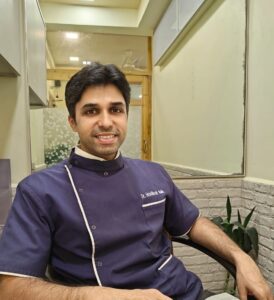
At PlanDental in Mahim West, children's pulp treatment is provided by Dr. Hrishikesh Naik and Dr. Nisha Naik, both MDS in Prosthodontics and Implantology. Very young or highly anxious children, or cases needing sedation, may be referred to a pediatric dental specialist. Read more about the clinic before you book.
Parents usually book this for: deep decay reaching the nerve a child's toothache that won't settle swelling near a baby tooth a dentist recommending pulp treatment over extraction wanting to avoid early tooth loss
Root canal treatment for children at PlanDental in Mahim, Mumbai treats decay or infection that has reached the nerve of a baby tooth, using either a pulpotomy (partial nerve removal) or a pulpectomy (full nerve removal), depending on how far the infection has progressed. Unlike an adult root canal, the tooth is filled with a material designed to resorb naturally as the tooth's own root resorbs, so it doesn't block the permanent tooth erupting beneath it.
A baby tooth's root is designed to dissolve, or resorb, as the permanent tooth underneath it develops and pushes upward — that's what eventually makes the baby tooth loose enough to fall out. Because of this, a permanent, non-resorbable filling material like the gutta-percha used in adult root canals can't be used here — it would block the primary tooth's root from resorbing normally and interfere with the permanent tooth's eruption path. Pediatric pulp therapy uses a resorbable material instead, so the whole tooth — filling included — resorbs on the same natural schedule.
The American Academy of Pediatric Dentistry's guidelines describe two distinct procedures depending on how much of the nerve is affected: a pulpotomy, which removes only the affected coronal (upper) portion of the nerve, and a pulpectomy, which removes the nerve tissue along the full length of the root canals — closer to what an adult root canal involves, but still using resorbable material.
Baby teeth hold space for the permanent teeth developing underneath them and guide those teeth into the correct position as they erupt. Losing a baby tooth too early — through untreated decay or an unnecessary extraction — can let neighbouring teeth drift into that space, making it harder for the permanent tooth to erupt where it should. Baby teeth also matter for chewing function and speech development during the years a child depends on them.
Removes only the affected upper portion of the nerve.
Removes nerve tissue along the full root canal length.
For very young or highly anxious children needing sedation to complete treatment safely.
Confirms how far the decay has reached and whether a pulpotomy or pulpectomy is appropriate.
The tooth and surrounding area are numbed before treatment begins.
The affected nerve tissue is removed — partially for a pulpotomy, fully for a pulpectomy.
The canal space is filled with a material designed to resorb on the same schedule as the tooth's own root.
A stainless steel crown is typically placed over the tooth afterward, since treated baby teeth are more prone to fracture.
Root canal treatment for children in Mumbai varies with whether a pulpotomy or pulpectomy is needed and whether a crown is placed afterward. PlanDental doesn't publish a fixed figure here — call or WhatsApp and the clinic will talk you through it after the exam.
This section describes what affects cost, not a quotation. Actual cost is confirmed only after an exam.
Pulp therapy is often possible even when a tooth looks badly decayed. Send an X-ray or exam notes on WhatsApp for a straight opinion before deciding.
Numbness wears off; a soft meal is easier until sensation fully returns.
Mild tenderness around the tooth is normal and settles quickly.
Normal brushing resumes; the crown restoration protects the tooth day to day.
Routine check-ups monitor the tooth until it naturally exfoliates.
A tooth already loose and close to natural exfoliation is usually better left to come out on its own or gently extracted, rather than treated.
Infection that has spread beyond the tooth into surrounding bone may need extraction rather than pulp therapy.
Very young children or those unable to tolerate a chairside procedure may need referral for sedation-based care.
Insufficient healthy tooth structure to place a crown afterward may make extraction the more practical option.
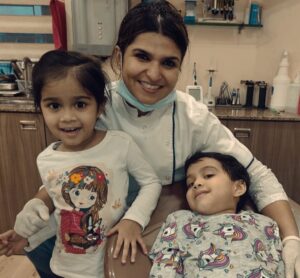
The visit starts with simple, age-appropriate explanation of what's about to happen before any instrument is used — a familiar approach in children's dentistry sometimes called "tell-show-do." Numbing is applied gently, and the procedure itself is paced to the child's comfort. Parents are welcome to stay close by during the visit.
Treatment decisions weigh what protects the permanent tooth's eruption path.
Sedation-level cases are referred rather than pushed through chairside.
Step-free walk-in access, Guru Nanak Road, Mahim West — no stairs.
Same Guru Nanak Road address, next to Citylight Cinema, for over a decade.
Removing a baby tooth too early can let neighbouring teeth drift into the space, making it harder for the permanent tooth to erupt correctly. Pulp treatment is preferred where the tooth can still be saved.
A pulpotomy removes only the affected upper portion of the nerve, used when the deeper nerve tissue is still healthy. A pulpectomy removes nerve tissue along the full root canal length, used when infection has spread further.
A baby tooth's root is designed to dissolve naturally as the permanent tooth erupts. A permanent filling material would block that process, so a resorbable material is used instead.
Usually yes — a stainless steel crown is typically placed afterward, since a tooth that's had pulp therapy is more prone to fracture without it.
The tooth is numbed with local anaesthesia beforehand, so the procedure itself shouldn't be painful. Mild tenderness for a day or two afterward is normal.
If infection has spread beyond what pulp therapy can resolve, extraction followed by a space maintainer is usually the better option.
Most children are managed well at a routine chairside visit. Very young or highly anxious children who need sedation to complete treatment safely are referred to a pediatric dental specialist.
Call or WhatsApp PlanDental to check today's availability or ask a question — no forms to fill.
Disclaimer: Information provided on this page is for educational purposes only. Individual treatment plans and outcomes vary based on clinical evaluation by a qualified dentist.