

A missing tooth affects more than appearance — it can shift how you chew, how neighbouring teeth sit, and over time, the bone that used to support it. There are several genuinely different ways to replace it, each suited to different situations.
At PlanDental in Mahim West, missing teeth are assessed by Dr. Hrishikesh Naik and Dr. Nisha Naik, both MDS in Prosthodontics and Implantology — prosthodontics is specifically the branch of dentistry focused on replacing missing teeth. Read more about the clinic before you book.
People search this for: one or more missing teeth a gap after an extraction difficulty chewing on one side shifting or drifting teeth comparing implants, bridges, or dentures
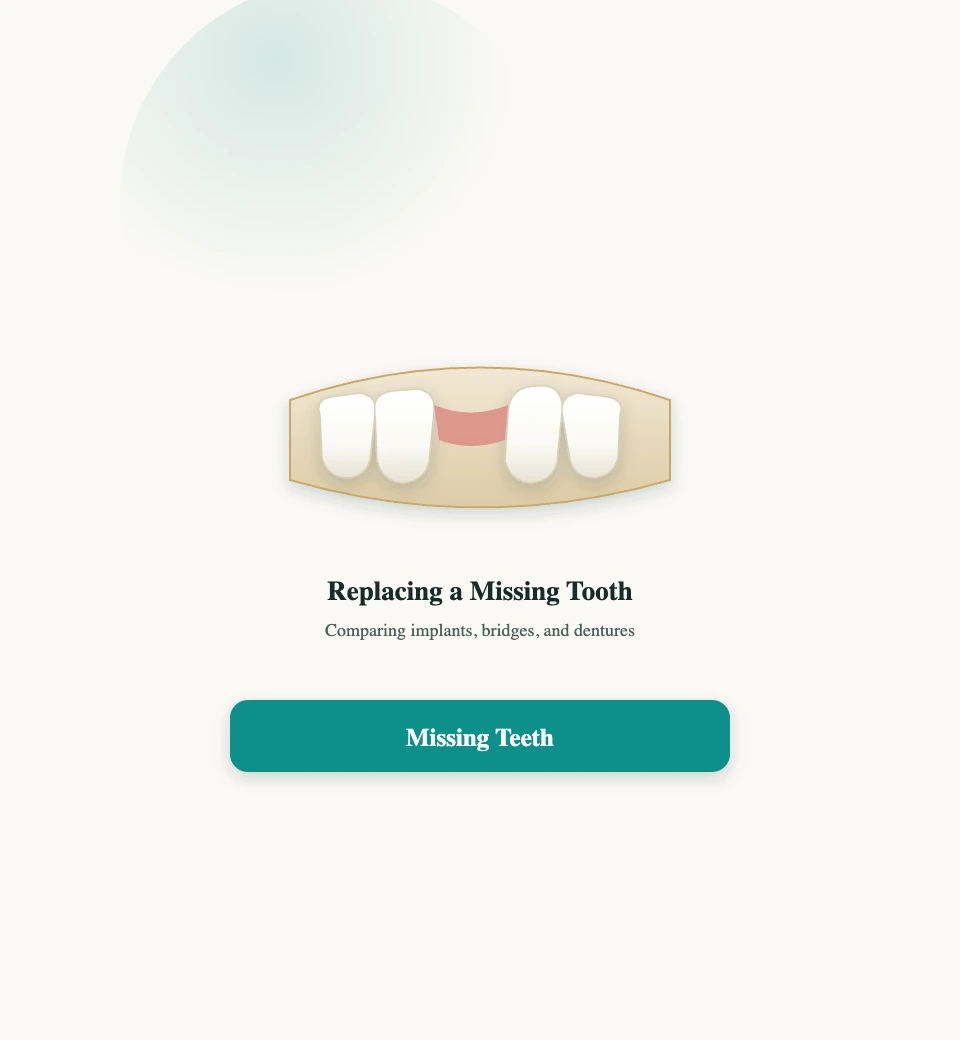
Missing teeth at PlanDental in Mahim, Mumbai are assessed to determine which replacement option fits best — a dental implant, a bridge, or a denture. The right choice depends on how many teeth are missing, where they are, the health of the surrounding bone and teeth, and your own preferences. Replacing a missing tooth isn't only cosmetic — leaving a gap unaddressed can lead to shifting teeth and bone loss over time.
Teeth work as a connected system — each one helps hold its neighbours in position and shares the work of chewing. Once a tooth is gone, neighbouring teeth can gradually tilt into the space, and the opposing tooth in the other jaw can slowly over-erupt without anything to meet it. The jawbone that used to support the missing tooth's root also begins to resorb over time, since bone needs the stimulation of a tooth root to maintain its density.
Dental implants replace the tooth root itself with a small titanium post placed in the jawbone, topped with a crown — this is the only option that also helps maintain bone at that site, since it gives the bone something to remodel around. Bridges replace a missing tooth by anchoring a replacement to the crowned teeth on either side of the gap — a good option when those teeth already need crowns. Dentures are removable appliances that can replace several teeth or an entire arch, and are often the most practical option when many teeth are missing.
A fixed, standalone replacement anchored in the jawbone.
A fixed replacement anchored to neighbouring teeth.
A removable option for several or all missing teeth.
Assesses the gap, the health of neighbouring teeth, and the jawbone underneath.
Whether avoiding surgery, minimising visits, or long-term bone health matters most to you.
You'll be walked through which of the three options genuinely fits your situation.
Once you've chosen, the relevant treatment page outlines exactly what happens next.
Cost varies significantly between implants, bridges, and dentures, and by how many teeth are involved. PlanDental doesn't publish a fixed figure here — call or WhatsApp and the clinic will talk you through the options after the exam.
This section describes what affects cost, not a quotation. Actual cost is confirmed only after an exam.
Implants, bridges, and dentures each have real trade-offs — a good consultation walks you through all three, not just one. Send your details on WhatsApp for a straight opinion.
Waiting a long time after a tooth is lost can reduce bone volume, which may affect which options remain suitable.
An implant needs adequate healthy bone and good general health to support healing — not every case is a straightforward fit.
A bridge relies on the health of the neighbouring teeth used as support — those teeth need to be sound or restorable.


Both doctors specialise specifically in tooth replacement, not general dentistry alone.
No default steering toward one option regardless of your case.
Step-free walk-in access, Guru Nanak Road, Mahim West — no stairs.
Same Guru Nanak Road address, next to Citylight Cinema, for over a decade.
It's still worth considering — even a back tooth affects chewing balance, and neighbouring or opposing teeth can shift or over-erupt over time.
An implant is a standalone replacement anchored in the jawbone. A bridge is anchored to the crowned teeth on either side of the gap, without needing bone surgery.
You can, but the jawbone at the site tends to lose density over time without a tooth root there, which can eventually narrow your options.
Dentures are generally better suited to several or all missing teeth. For a single tooth, an implant or bridge is usually more practical.
It depends on how many teeth are missing, the condition of neighbouring teeth, your jawbone, and your own priorities — an exam and conversation covers all of this.
Yes — jawbone needs the stimulation of a tooth root to maintain its density, so it tends to gradually resorb once a tooth is lost.
Call or WhatsApp PlanDental to check today's availability or ask a question — no forms to fill.
Disclaimer: Information provided on this page is for educational purposes only. Individual treatment plans and outcomes vary based on clinical evaluation by a qualified dentist.