

"Braces treatment" covers several different bracket and aligner systems for straightening teeth and correcting bite — this page gives an honest overview of each, and how PlanDental fits into your care alongside the treating orthodontist.
At PlanDental in Mahim West, orthodontic evaluations and dental health monitoring during treatment are provided by Dr. Hrishikesh Naik and Dr. Nisha Naik, both MDS in Prosthodontics and Implantology. The bracket or aligner treatment itself is coordinated with an orthodontist. Read more about the clinic before you book.
Patients usually book this for: crowded or crooked teeth gaps between teeth bite correction comparing braces vs clear aligners
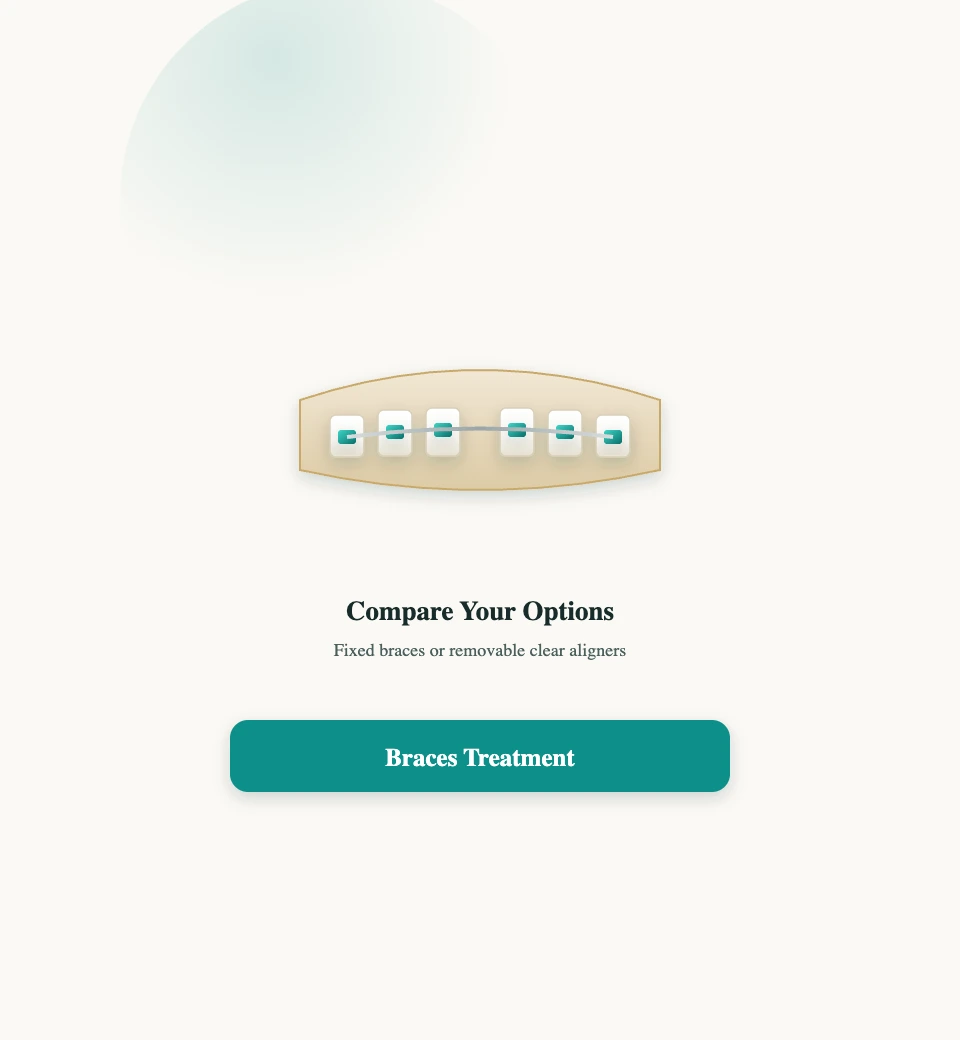
Braces treatment uses brackets and wires, or a series of clear removable aligners, to gradually move teeth into better alignment and correct bite problems. The main systems are metal braces, ceramic braces, self-ligating braces, and lingual braces (all fixed appliances), plus clear aligners and Invisalign (removable). At PlanDental, the evaluation and ongoing dental health monitoring during treatment are provided in-house; fitting and adjusting the appliance itself is coordinated with an orthodontist.
All orthodontic treatment works on the same underlying principle — applying gentle, sustained pressure to guide teeth into a new position over time. The systems differ mainly in how that pressure is applied and how visible the appliance is. Fixed braces (metal, ceramic, self-ligating, or lingual) are bonded to the teeth and adjusted periodically by the orthodontist. Clear aligners and Invisalign are a series of custom, removable trays that are swapped out every one to two weeks.
PlanDental assesses your teeth, bite, and gum health, and takes any needed records.
Your case is discussed with a coordinating orthodontist, who recommends and plans the specific system.
Brackets are adjusted, or aligners are changed, periodically over the treatment course.
A retainer holds the new position in place once active treatment ends.
Orthodontic treatment cost in Mumbai varies widely by system, case complexity, and treatment duration. PlanDental doesn't publish a fixed figure here — call or WhatsApp for a referral and the coordinating orthodontist will confirm cost after assessment.
This section describes what affects cost, not a quotation. Actual cost is confirmed by the treating orthodontist.
Send a photo of your smile and your concerns on WhatsApp — PlanDental can point you toward the right next step and coordinate an orthodontist referral.
Extra care with cleaning around brackets or aligners helps prevent decay.
Routine dental check-ups continue alongside orthodontic adjustment visits.
A retainer is fitted to hold the new position.
Consistent retainer wear is important to prevent teeth drifting back.
Orthodontic treatment is a multi-month to multi-year commitment — it isn't a quick fix.
The actual bracket fitting and adjustment is coordinated with an orthodontist, not performed at PlanDental directly.
Skipping retainer wear after treatment can allow teeth to drift back over time.


Evaluation and monitoring here; bracket/aligner work coordinated with an orthodontist.
Underlying gum issues are addressed before treatment begins.
Step-free walk-in access, Guru Nanak Road, Mahim West — no stairs.
Same Guru Nanak Road address, next to Citylight Cinema, for over a decade.
PlanDental provides the initial evaluation and ongoing dental health monitoring during treatment. Fitting and adjusting braces or aligners is coordinated with an orthodontist.
It depends on your specific crowding, bite, and priorities around visibility and cost — this is assessed and recommended by the treating orthodontist after your evaluation.
It varies by case complexity and system, but typically spans many months up to around two years for more complex cases.
Yes — orthodontic treatment isn't limited to children or teenagers, and many adults undergo treatment successfully.
Active gum disease is generally addressed first, since moving teeth through unhealthy gum tissue can complicate treatment. See Gum Disease Treatment.
A retainer is fitted to hold the new position — consistent wear afterward is important to prevent teeth drifting back.
Call or WhatsApp PlanDental to check today's availability or ask a question — no forms to fill.
Disclaimer: Information provided on this page is for educational purposes only. Individual treatment plans and outcomes vary based on clinical evaluation by a qualified dentist or orthodontist.