
"Full mouth dental implants" covers more than one approach to replacing all the teeth in a jaw with an implant-supported set — this page compares the main options honestly, including All-on-4 and All-on-6, so you can see how they differ.
At PlanDental in Mahim West, full-arch implant planning is led by Dr. Hrishikesh Naik and Dr. Nisha Naik, both MDS in Prosthodontics and Implantology. Read more about the clinic before you book.
Patients usually book this for: most or all teeth missing in a jaw tired of loose dentures comparing All-on-4 vs All-on-6 wanting a fixed, non-removable option
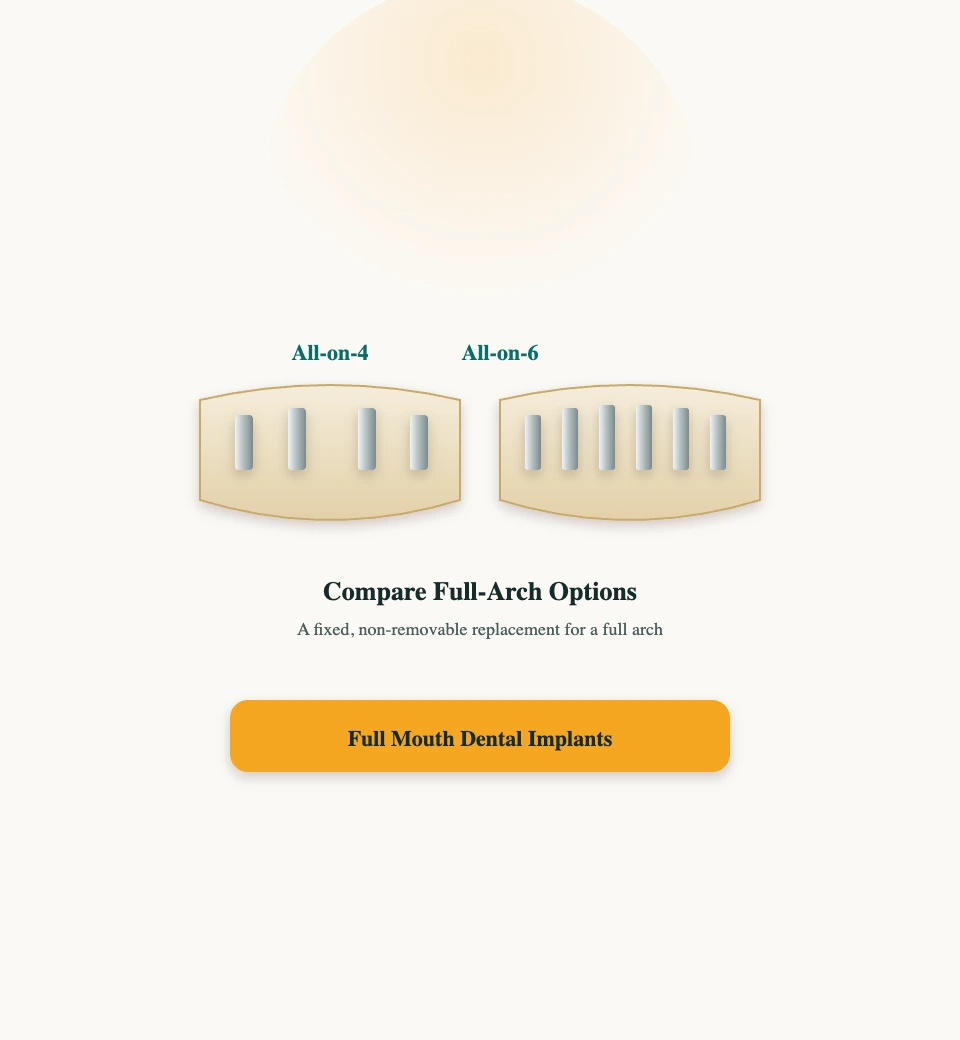
"Full mouth dental implants" is an umbrella term, not one single technique. The two most common protocols are All-on-4 (four implants supporting a full fixed arch) and All-on-6 (six implants, offering more support and redundancy). Both replace an entire arch of missing or failing teeth with a fixed, non-removable set — the right choice depends on your bone volume, bite forces, and what your dentist recommends after assessment.
When most or all of the teeth in a jaw are missing, failing, or badly compromised, replacing them one by one with individual implants usually isn't practical or necessary. Instead, a small number of strategically placed implants can support an entire fixed arch of replacement teeth. The two established protocols for this — All-on-4 and All-on-6 — differ mainly in how many implants are used and how they're positioned, which affects the support, cost drivers, and candidacy for each.
Four implants, angled posteriors, support a full fixed arch.
Six implants for extra support and redundancy.
Not a full-arch scenario.
A non-surgical, removable alternative.
Detailed imaging maps bone volume across the jaw to decide between All-on-4, All-on-6, or another plan.
The chosen number of implants is placed at planned positions in the jaw.
The implants integrate with the bone over several months before final loading.
A full fixed replacement arch is attached to the healed implants.
Full-arch implant cost in Mumbai depends heavily on which protocol is used (All-on-4 vs All-on-6) and whether bone grafting is needed. PlanDental doesn't publish a fixed figure here — call or WhatsApp and the clinic will talk you through it after the assessment.
This section describes what affects cost, not a quotation. Actual cost is confirmed only after the assessment.
Send your details and X-rays (if you have them) on WhatsApp for a straight comparison of All-on-4 vs All-on-6 for your case.
Soft-food diet and mild swelling are expected right after surgery.
Regular check-ups monitor integration of every implant.
The fixed arch functions much like natural teeth for eating and speaking.
Periodic professional cleaning around the implants and prosthesis is important.
Very limited bone volume may need grafting before implants can be placed, extending the timeline.
Uncontrolled diabetes or heavy smoking can affect how well the implants integrate.
This is a bigger surgical undertaking than a single implant or a denture — it's discussed thoroughly before you commit.

Neither protocol is pushed by default — the right one is recommended after assessment.
Candidacy is based on your actual imaging, not assumed.
Step-free walk-in access, Guru Nanak Road, Mahim West — no stairs.
Same Guru Nanak Road address, next to Citylight Cinema, for over a decade.
All-on-4 uses four implants per arch, with the back two angled to make the most of available bone. All-on-6 uses six implants, offering additional support and redundancy. Which suits you depends on your bone volume and bite.
No — full mouth implants are fixed to implants in the jawbone and don't come out, while conventional dentures rest on the gums and are removable. See Dentures for the removable alternative.
The full process, from placement to final fixed arch, typically spans several months to allow proper healing and integration.
Often yes, though bone volume can reduce over years of denture wear — this is assessed with imaging before recommending a plan.
Not always. It depends on how much bone remains in the jaw, which is evaluated during your assessment.
This depends on which arch has extensive tooth loss or failing teeth — many patients need only the upper or lower jaw treated, others need both.
Call or WhatsApp PlanDental to check today's availability or ask a question — no forms to fill.
Disclaimer: Information provided on this page is for educational purposes only. Individual treatment plans and outcomes vary based on clinical evaluation by a qualified dentist.