

Periodontal treatment is the ongoing management plan for periodontitis — the stage of gum disease where bone and attachment have already been lost. The goal is stopping further loss and keeping what remains, since existing bone loss doesn't regenerate on its own.
At PlanDental in Mahim West, periodontal management is overseen by Dr. Hrishikesh Naik and Dr. Nisha Naik, both MDS in Prosthodontics and Implantology from Nair Hospital Dental College. If you haven't yet had a diagnostic exam, start with Gum Disease Treatment to confirm the stage first. Read more about the clinic before you book.
Patients usually book this for: already diagnosed with periodontitis gum pockets measured as deep bone loss confirmed on X-ray teeth feeling slightly loose wanting a maintenance schedule set up
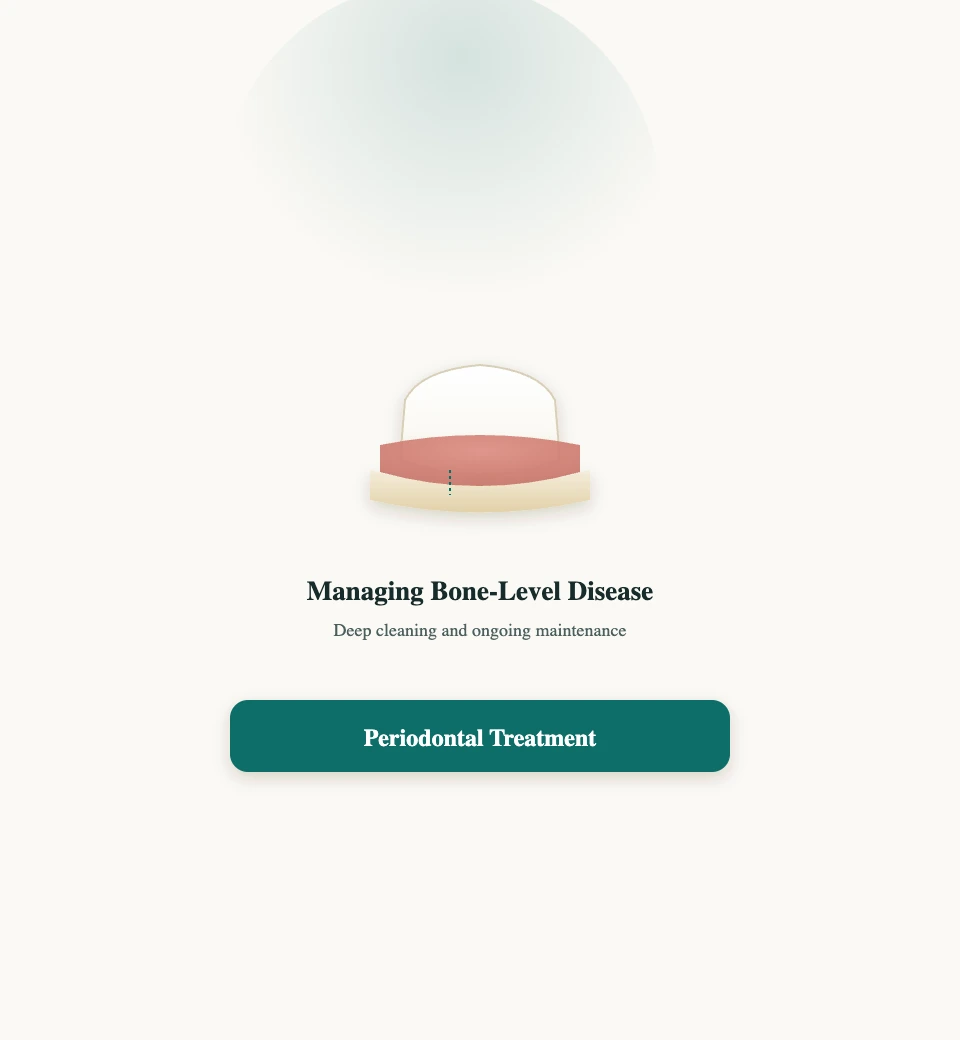
Periodontal treatment at PlanDental in Mahim, Mumbai is the ongoing care plan for periodontitis — confirmed gum and bone loss beyond the reversible gingivitis stage. It centres on non-surgical deep cleaning and a structured recall schedule, with referral to a periodontist for surgical procedures where the disease has advanced beyond what non-surgical care can control. This page covers what "ongoing management" actually looks like, appointment by appointment.
Periodontitis means the inflammation from gum disease has reached the bone and connective tissue holding a tooth in place, and some of that support has already been lost. Unlike gingivitis, this loss doesn't grow back with a cleaning — the treatment goal shifts from "reverse it" to "stop it from getting worse and hold onto what's left."
This is different from the Gum Disease Treatment page, which is the entry-point diagnostic overview covering the full spectrum from early inflammation to advanced disease. This page goes deeper into what the periodontitis-specific management plan involves once that diagnosis is confirmed: staging, maintenance frequency, and what happens if a case needs more than non-surgical care.
Periodontal treatment applies once pocket depths and X-rays confirm bone loss, not before.
Bone lost to periodontitis does not regrow through routine dental treatment. Once the disease has affected the bone, the realistic clinical goal is arresting its progression — removing the bacterial deposits that drive it and keeping them from re-establishing at the depth they'd already reached. That's an ongoing job, because the pockets created by prior bone loss are naturally harder to keep clean than healthy gum margins, and they refill with plaque faster if left unmonitored.
This is why periodontal maintenance visits are more frequent than a standard six-month cleaning — usually every three to four months — and why the plan is described as management rather than a cure.
Treatment intensity depends on how advanced the disease is at diagnosis.
Below-gumline cleaning plus a structured recall schedule.
For advanced, localised defects that don't respond to non-surgical care.
Infrequent cleaning without a structured recall plan.
Pocket depths are measured tooth by tooth and compared against X-ray findings to confirm severity.
Tartar and bacterial deposits are removed from below the gum line and root surfaces are smoothed.
Pockets are remeasured several weeks later to check the response to treatment.
A recall interval — typically every three to four months — is set based on how the case responded.
Cases that don't stabilise, or that have advanced, localised defects, are referred for periodontal surgery.
Periodontal treatment cost in Mumbai depends on how many quadrants need deep cleaning and how many maintenance visits the case requires over the following year. PlanDental doesn't publish a fixed figure here — call or WhatsApp and the clinic will talk you through it after the staging exam.
This section describes what affects cost, not a quotation. Actual cost is confirmed only after the staging exam.
Many periodontitis cases are managed non-surgically first, with surgery reserved for what doesn't respond. Send your X-rays or exam notes on WhatsApp for a straight opinion.
Some root sensitivity is common after deep cleaning; gums begin to tighten around the tooth as inflammation settles.
Pockets are remeasured to confirm the response and decide if surgery is needed.
Periodontal maintenance visits continue at this interval rather than the standard six months.
Home care consistency and smoking status are reassessed at every visit, since both directly affect stability.
Deep, localised pockets that don't respond to cleaning after re-evaluation typically need surgical access, referred to a periodontist.
Significant tooth mobility or advanced bone loss around specific teeth may need a specialist opinion on long-term prognosis.
Smoking measurably slows healing and reduces how well non-surgical treatment holds — this is factored into expectations set with you.
Uncontrolled diabetes can affect how well gum tissue responds to treatment, and is coordinated with your physician where relevant.
The first visit is the staging exam and, usually, the first round of deep cleaning under local anaesthesia. Later visits are shorter maintenance cleanings, plus a check of pocket depths to catch any change early. Because this is a recurring relationship rather than a one-off, the same dentist tracks your numbers over time — which is what makes it possible to catch a site that's starting to worsen before it becomes a bigger problem.


Pocket depths are recorded and compared visit to visit, not re-measured from scratch.
Advanced cases are referred to a periodontist rather than managed beyond what's appropriate here.
Step-free walk-in access, Guru Nanak Road, Mahim West — no stairs.
Same Guru Nanak Road address, next to Citylight Cinema, for over a decade.
Typically every three to four months, more often than the standard six-month cleaning interval, since periodontal pockets refill with plaque faster than healthy gum margins.
Bone lost to periodontitis doesn't regrow through routine treatment, so it's managed rather than cured. The goal is stopping further loss and keeping what's left stable long-term.
Not necessarily — with consistent maintenance, many cases stay stable for years. Risk depends on how advanced the disease was at diagnosis and how consistently the maintenance plan is followed.
Deep cleaning is done under local anaesthesia, so the appointment itself shouldn't be painful. Some root sensitivity is common for a few days to weeks afterward.
No — most mild to moderate cases are managed with non-surgical deep cleaning and maintenance. Surgery is reserved for advanced or non-responsive cases and is handled by referral.
Research has found associations between periodontal disease and conditions like diabetes and cardiovascular disease, which is part of why ongoing management matters beyond just the teeth involved.
Pockets that aren't kept clean at the recommended interval are more likely to worsen, since periodontitis doesn't stay stable on its own without ongoing care.
Gum Disease Treatment is the entry-point page covering the full spectrum and how a diagnosis is reached. This page covers the specific ongoing plan once periodontitis is confirmed.
1. American Academy of Periodontology / American Dental Association — Clinical Practice Guideline on the nonsurgical treatment of chronic periodontitis, Journal of the American Dental Association. jada.ada.org
2. Genco RJ, Borgnakke WS — "Risk factors for periodontal disease," Periodontology 2000, available via PubMed Central. ncbi.nlm.nih.gov/pmc
Call or WhatsApp PlanDental to check today's availability or ask a question — no forms to fill.
Disclaimer: Information provided on this page is for educational purposes only. Individual treatment plans and outcomes vary based on clinical evaluation by a qualified dentist.