

Lingual braces are bonded to the back (tongue-side) of the teeth instead of the front, making them essentially invisible in conversation — the most discreet of the fixed braces systems, with some real trade-offs to weigh.
At PlanDental in Mahim West, the initial evaluation and dental health monitoring during treatment are provided by Dr. Hrishikesh Naik and Dr. Nisha Naik, both MDS in Prosthodontics and Implantology. Fitting and adjusting the braces themselves is coordinated with an orthodontist experienced in lingual technique. Read more about the clinic before you book.
Patients usually book this for: wanting a fully invisible fixed option public-facing professions crowded or crooked teeth comparing lingual vs clear aligners
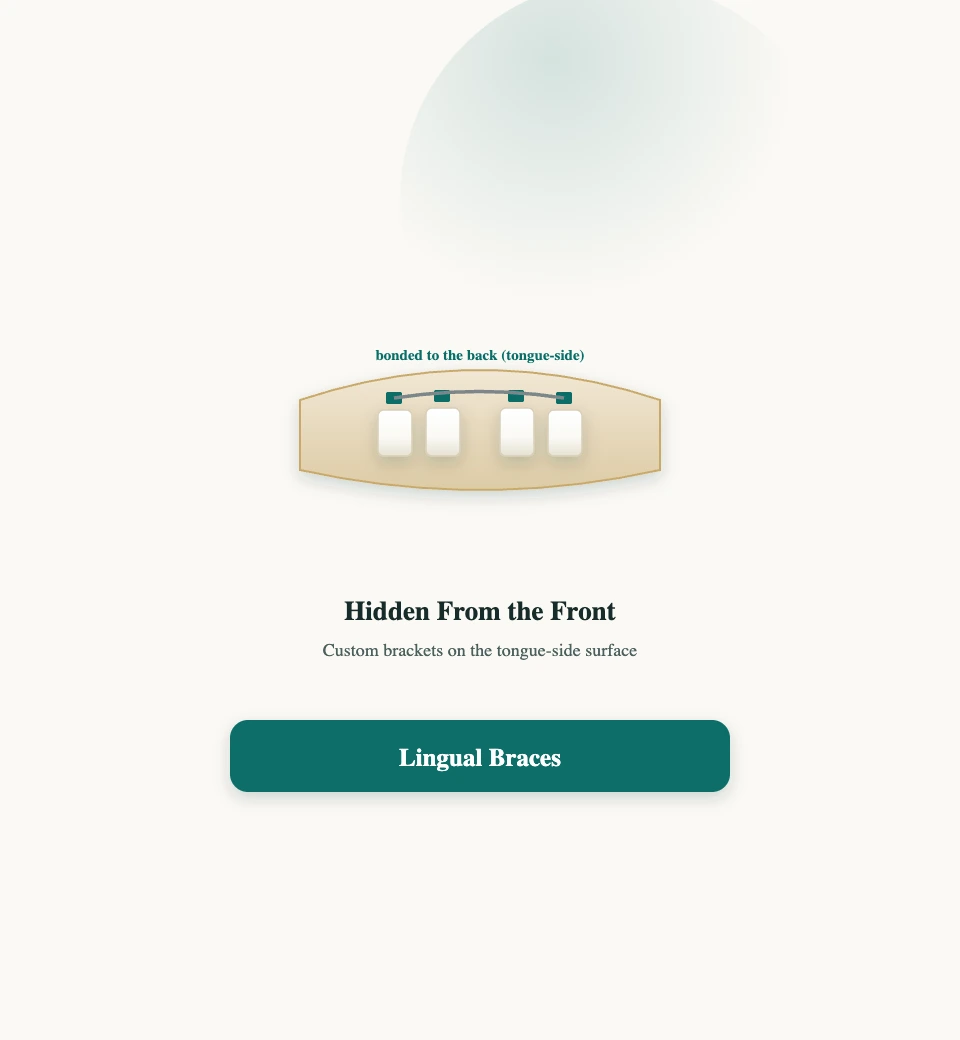
Lingual braces work on the same bracket-and-archwire principle as regular braces, but the brackets are custom-fitted to the back surface of each tooth, facing the tongue. This makes them invisible when you smile or talk. The trade-off is technical complexity — the tighter spacing between brackets on the back of the teeth makes lingual braces more sensitive to adjustment and typically involves more chair time per visit than front-mounted systems, along with an initial adjustment period for speech and tongue comfort.
Because lingual braces sit on the tongue-side of the teeth, each bracket has to be custom-fitted to that tooth's specific back surface — the space between teeth is narrower there than on the front, which makes the appliance more sensitive to wire adjustments. Orthodontist surveys report that patient discomfort, longer chair time, and technical difficulty are the main challenges practitioners encounter with lingual technique, alongside an adjustment period where speech (particularly certain sounds) and tongue comfort take some time to settle.
Fixed appliance, fully hidden from the front.
Removable, nearly invisible trays.
Tooth-colored, less visible than metal.
PlanDental assesses your teeth, bite, and gum health, and takes any needed records.
Your case is discussed with a coordinating orthodontist experienced in lingual technique, who plans custom brackets for each tooth's back surface.
Custom brackets are bonded behind the teeth; adjustment visits typically run longer than for front-mounted braces.
A retainer holds the new position in place once active treatment ends.
Lingual braces are generally the most expensive fixed braces option in Mumbai, reflecting the custom bracket fabrication and additional chair time involved. PlanDental doesn't publish a fixed figure here — call or WhatsApp for a referral and the coordinating orthodontist will confirm cost after assessment.
This section describes what affects cost, not a quotation. Actual cost is confirmed by the treating orthodontist.
Send a photo of your smile and your priorities on WhatsApp for honest guidance on which invisible option fits your case.
Some speech changes and tongue irritation are common while adjusting.
Careful cleaning behind the teeth is important, since it's harder to see.
Brackets are removed and a retainer is fitted.
Consistent retainer wear helps prevent teeth drifting back.
Speech changes and tongue irritation are common in the first couple of weeks as you adjust.
Adjustment visits typically take longer than for front-mounted braces, due to the technical complexity involved.
Generally the most expensive fixed braces option.
Very complex cases may be better suited to a different system — this is confirmed by the treating orthodontist.


Speech adjustment, cost, and complexity explained clearly upfront.
Referral to an orthodontist experienced in lingual technique specifically.
Step-free walk-in access, Guru Nanak Road, Mahim West — no stairs.
Same Guru Nanak Road address, next to Citylight Cinema, for over a decade.
Yes — since they're bonded to the back of the teeth, they aren't visible when you smile or talk.
Some speech changes, particularly with certain sounds, are common in the first couple of weeks while your tongue adjusts, and typically settle after that.
The brackets are custom-fabricated for the back surface of each tooth, and adjustment visits take longer due to the technical complexity — both factors contribute to the higher cost.
Many cases can be treated with lingual braces, though very complex crowding or jaw correction is assessed individually by your orthodontist.
Generally longer than for front-mounted braces, since the tighter spacing on the back of the teeth makes the appliance more sensitive to adjustment.
PlanDental provides the initial evaluation and ongoing dental health monitoring during treatment. Fitting and adjusting the braces is coordinated with an orthodontist experienced in lingual technique.
1. Practice of lingual orthodontics and practitioners' opinion and experience with lingual braces in the United States — PMC. ncbi.nlm.nih.gov
Call or WhatsApp PlanDental to check today's availability or ask a question — no forms to fill.
Disclaimer: Information provided on this page is for educational purposes only. Individual treatment plans and outcomes vary based on clinical evaluation by a qualified dentist or orthodontist.