

Crooked teeth in adults and teens usually come down to a mismatch between tooth size and jaw size, an early tooth lost without space maintenance, or a longstanding habit — and today's orthodontic options go well beyond traditional metal braces.
At PlanDental in Mahim West, crooked teeth are assessed by Dr. Hrishikesh Naik and Dr. Nisha Naik, both MDS in Prosthodontics and Implantology, with orthodontic treatment itself coordinated with an orthodontist. If you're looking for the age-7 children's screening instead, see Braces for Kids. Read more about the clinic before you book.
People search this for: crowded front teeth teeth that overlap slightly a tooth that never had space to erupt properly teeth shifted after losing another tooth wanting a straighter smile as an adult
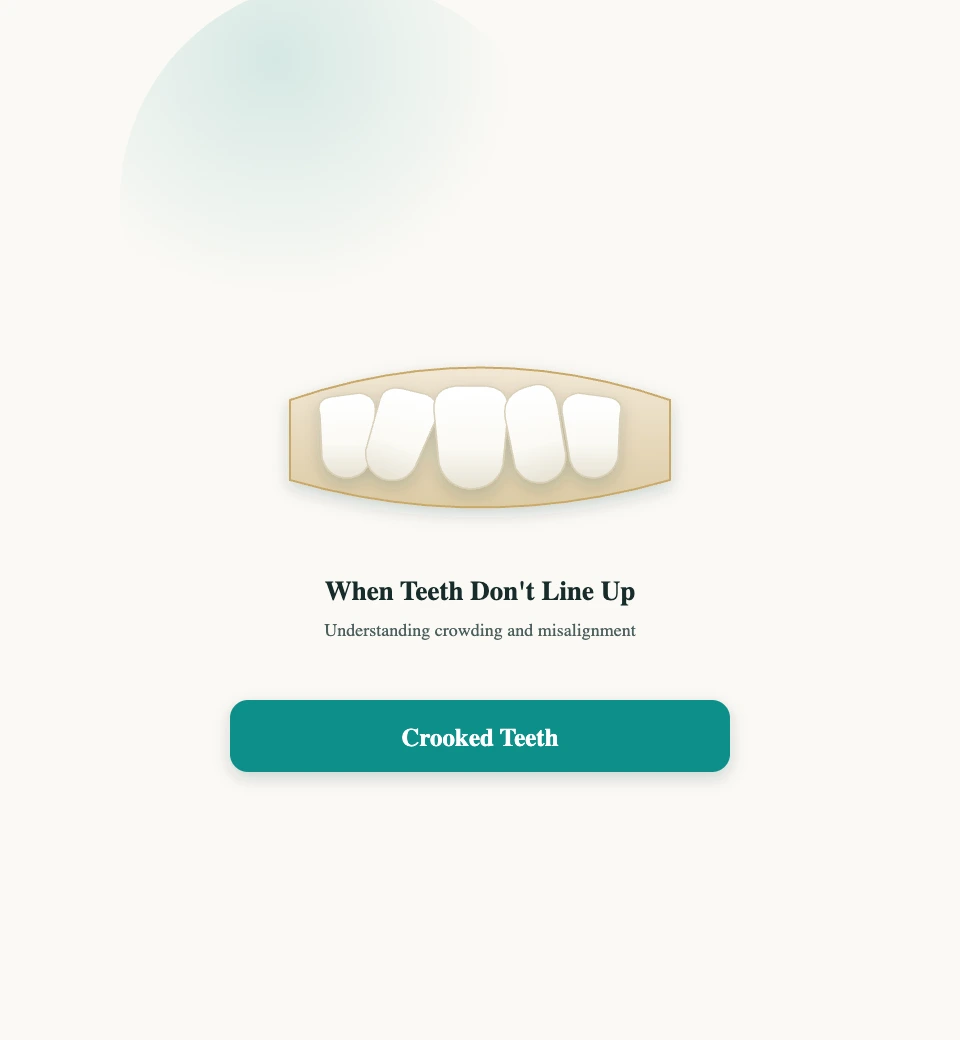
Crooked teeth in adults and older teens are assessed at PlanDental in Mahim, Mumbai by looking at the underlying cause — usually not enough room in the jaw for all the teeth, an early tooth loss that let neighbouring teeth drift, or a longstanding habit affecting bite development. Where bracket-based or aligner treatment is the right fit, it's coordinated with an orthodontist for the appliance work itself.
Crowding and misalignment most often come down to a simple space problem — the jaw doesn't have quite enough room for every tooth to sit in its ideal position, so some rotate, overlap, or push forward. This can be genetic (inherited jaw and tooth size), or it can develop from an early tooth loss that let neighbouring teeth drift into the gap, or from habits during childhood that affected how the bite developed.
Genetics can produce teeth that are simply too large for the available jaw space.
A tooth lost without a space maintainer lets neighbouring teeth drift into the gap.
Prolonged thumb-sucking or tongue thrust can affect how the bite develops over time.
Advanced bone loss can let teeth shift position in adulthood.
Traditional bracket-based treatment for a wide range of crowding.
A less visible option for suitable cases of mild to moderate crowding.
Prevents further drift while a permanent solution is planned.
Not every case of crowding suits every appliance — mild cases sometimes qualify for aligners where more complex ones need braces. Send your details on WhatsApp for a straight opinion.
Active gum disease is treated first — moving teeth through inflamed, unhealthy bone isn't appropriate.
Clear aligners aren't suitable for every type or severity of crowding — this is confirmed at assessment, not assumed.
The appliance fitting and adjustment itself is coordinated with an orthodontist, not performed at this assessment.
New adult crowding is investigated for a periodontal cause.
Appliance work is coordinated with an orthodontist, not guessed at.
Step-free walk-in access, Guru Nanak Road, Mahim West — no stairs.
Same Guru Nanak Road address, next to Citylight Cinema, for over a decade.
Adults can straighten crooked teeth with braces or clear aligners — orthodontic treatment isn't limited to children or teens.
New crowding in adulthood is sometimes linked to gum disease and bone loss allowing teeth to shift — worth checking alongside the crowding itself.
For suitable, typically milder cases, yes — but not every type of crowding is a good fit for aligners, which is confirmed at assessment.
PlanDental assesses the cause and coordinates with an orthodontist for the actual appliance work, since that requires orthodontic training specifically.
It can — without a space maintainer or timely replacement, neighbouring teeth can drift into the gap over time.
Crowded teeth can be harder to clean thoroughly, which may increase the risk of decay and gum disease in tightly overlapping areas.
Call or WhatsApp PlanDental to check today's availability or ask a question — no forms to fill.
Disclaimer: Information provided on this page is for educational purposes only. Individual treatment plans and outcomes vary based on clinical evaluation by a qualified dentist or orthodontist.