

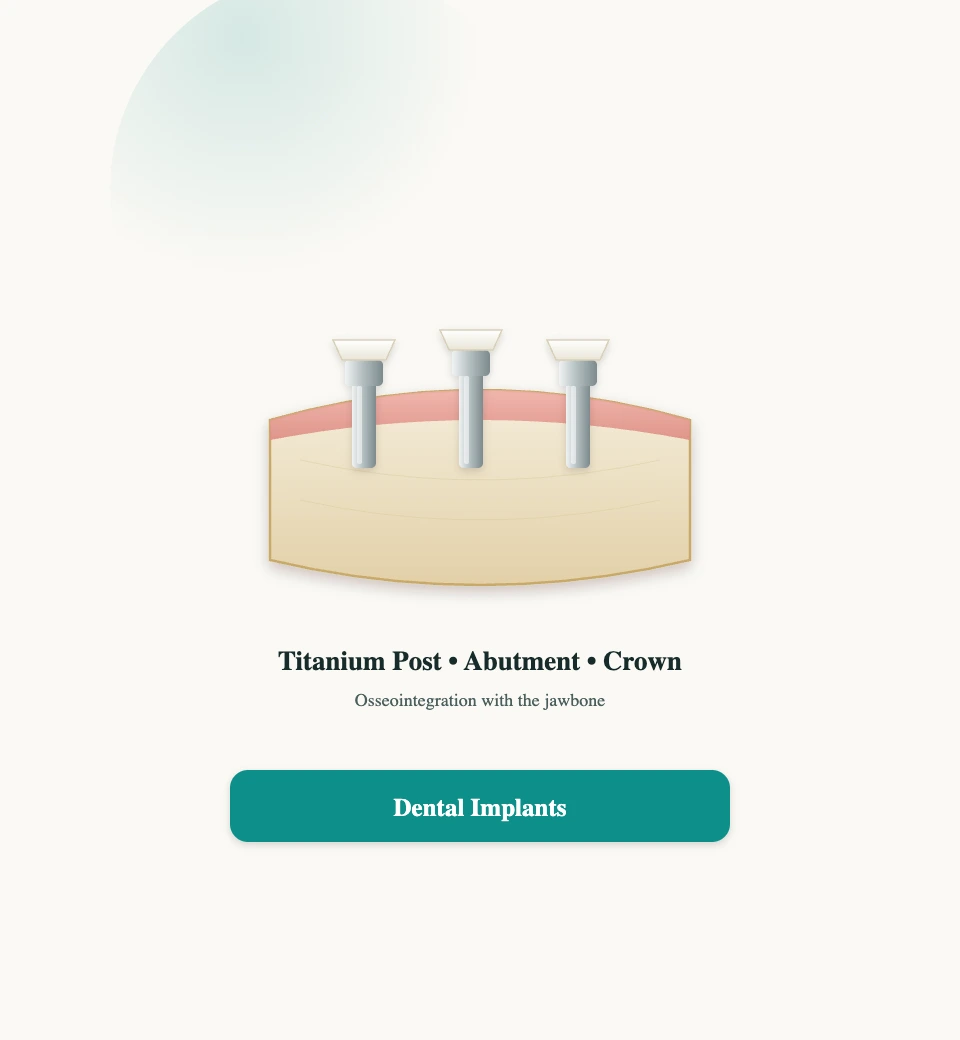
A dental implant replaces a missing tooth's root with a small titanium post placed in the jawbone, topped with a crown — a standalone, fixed replacement that doesn't rely on neighbouring teeth.
At PlanDental in Mahim West, implants are placed and restored by Dr. Hrishikesh Naik and Dr. Nisha Naik, both MDS in Prosthodontics and Implantology. Read more about the clinic before you book.
Patients usually book this for: one missing tooth several missing teeth an entire arch needing replacement wanting a fixed, non-removable option avoiding crowning healthy neighbouring teeth
*Per long-term clinical studies on implant osseointegration — see References below.
A dental implant at PlanDental in Mahim, Mumbai consists of a titanium post placed in the jawbone, an abutment connector, and a crown on top — together replacing a missing tooth's root and visible structure. Long-term studies report implant success rates in the range of roughly 93–96% over more than a decade. Whether one implant, several, or a full-arch approach fits your case depends on how many teeth are missing — see Single Tooth Implant and Full Mouth Dental Implants for the specific scenarios.
An implant works through a process called osseointegration — the jawbone gradually fuses to the surface of the titanium post over a period of months, creating a stable, structural bond similar in function to a natural tooth root. Once that healing is complete, an abutment connects the post to a crown, restoring the visible part of the tooth. This is also what makes implants unique among replacement options: because the post is anchored directly in bone, it provides the same kind of stimulation a natural tooth root does, helping maintain bone density at that site.
X-rays confirm bone volume and plan the exact implant position.
The titanium post is placed into the jawbone under local anaesthesia.
The bone fuses to the implant surface over roughly 3–4 months in the lower jaw, or 6–8 months in the upper jaw.
Once healed, the abutment and final crown or prosthesis are fitted.
Dental implant cost in Mumbai depends heavily on how many implants are needed and whether additional procedures, like bone grafting, are required. PlanDental doesn't publish a fixed figure here — call or WhatsApp and the clinic will talk you through it after the assessment.
This section describes what affects cost, not a quotation. Actual cost is confirmed only after the assessment.
Bone grafting can sometimes make implants possible even where bone volume initially looked insufficient. Send your X-ray or exam notes on WhatsApp for a straight opinion.
Mild swelling and tenderness at the surgical site are common.
Regular check-ups monitor osseointegration progress.
The implant functions and is cleaned much like a natural tooth.
Routine check-ups monitor the implant and surrounding gum tissue long-term.
Insufficient bone volume may need to be addressed with bone grafting before an implant is placed.
Uncontrolled diabetes or heavy smoking can meaningfully reduce osseointegration success.
Poor oral hygiene around an implant can lead to gum inflammation and, over time, bone loss around it.
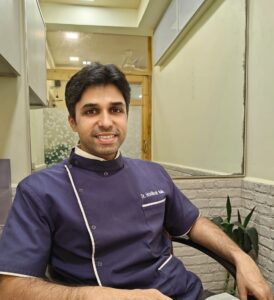

Implant placement and restoration is a named part of both doctors' MDS training.
Candidacy is based on your actual X-ray, not assumed.
Step-free walk-in access, Guru Nanak Road, Mahim West — no stairs.
Same Guru Nanak Road address, next to Citylight Cinema, for over a decade.
Long-term clinical studies report success rates generally in the low-to-mid 90s percent, with some studies showing over 96% survival at 12 years, depending on the study and follow-up period.
The bone needs time to physically fuse to the implant surface — a biological process called osseointegration that typically takes 3 to 4 months in the lower jaw and 6 to 8 months in the upper jaw.
Bone grafting can sometimes build up the site enough to support an implant — this is assessed and discussed at your consultation if bone volume is a concern.
An implant is a standalone replacement anchored in the jawbone, without involving neighbouring teeth. A bridge relies on the teeth next to the gap for support.
They're cleaned much like natural teeth, but consistent oral hygiene remains important — without it, gum inflammation and bone loss around the implant can develop over time.
Yes — heavy smoking is a recognised factor that can reduce how well an implant integrates with the bone.
1. Long-term clinical studies on acid-etched and sandblasted dental implant survival and osseointegration success rates, indexed on PubMed Central. ncbi.nlm.nih.gov/pmc
Call or WhatsApp PlanDental to check today's availability or ask a question — no forms to fill.
Disclaimer: Information provided on this page is for educational purposes only. Individual treatment plans and outcomes vary based on clinical evaluation by a qualified dentist.